A DAY WITH DR. FRED
OUR NEXT PLANET
or
WHY, WHEN, AND HOW HUMANS WILL SETTLE ANOTHER WORLD
This program, developed from the keynote address for the Idaho National Engineering and Environmental Laboratory's second annual Science and Engineering Exposition and the 2002 Snake River Roaring Youth Jam, is most appropriate for students from grade 3 up. It can be adapted for younger audiences.
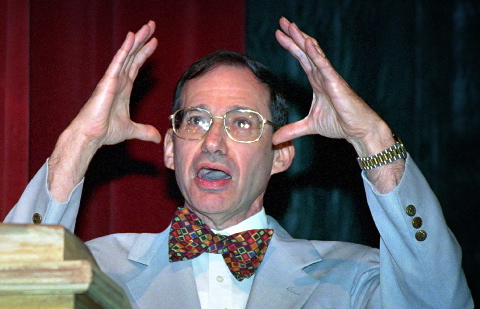
Dr. Fred presents "Our Next Planet," August 7, 2002
Photo courtesy Ron Paarmann, Idaho National Engineering and Environmental Laboratory
Anonymous feedback from teachers and media specialists who experienced the "Our Next Planet" program at the 10th annual Children's Literature Conference at the University of Pittsburgh at Greensburg, May 5, 2006:
- Excellent.
- I think students would love this presentation. Very thought provoking.
- Whooo I want to be on his spaceship!
- Helped me remember what it was like to be 10 & fascinated with astronomy
- Very knowledgeable about subject.
Other recent comments:
- Your presentation sparked some interesting and thoughtful debate from the students, which is always great to hear. (Greater Latrobe High School - PA, Dec. 2007)
- Thanks again for coming and jump-starting our 'love to read' week. We're all wearing bow ties today in your honor. (Hambden Elementary School, Chardon, OH, grades K-5, May 2008)
- On behalf of the students and staff at Schechter, I want to thank you for the science presentations last week. Students continue to ask questions and think about the issues you raised. Exactly what we want to happen. (Gross Schechter Day School, Pepper Pike, OH, grades 3-5, May 2008)
If you'd like to download a colorful one-page "Day with Dr. Fred" brochure to share with others in your school or town, this link should get you a printable Adobe .pdf version (680 Kbyte).
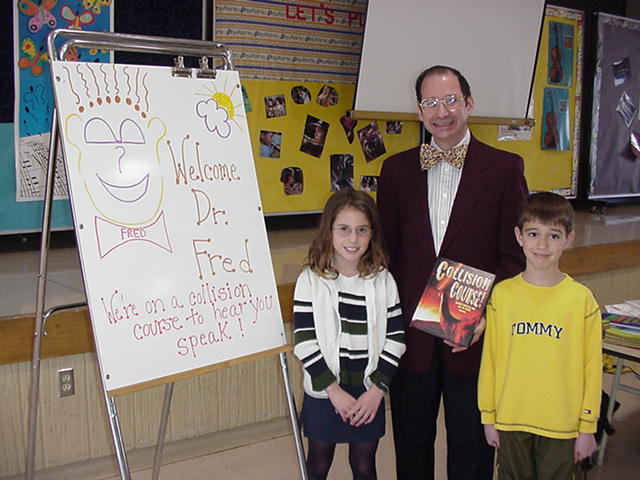
QUESTIONS? E-mail Dr. Fred
Click here for Dr. Fred's other program, "The Truth About Space Aliens".
"A DAY WITH DR. FRED" SUPPORTS INQUIRY-BASED SCIENCE
AND CROSS-DISCIPLINARY LEARNING
The "Day With Dr. Fred" Program was developed especially to:
- enhance the use of inquiry in the science classroom;
- to reinforce the idea that literature includes nonfiction as well as fiction;
- to encourage reluctant readers to try "true stories";
- to demonstrate the interrelationships among all areas of the curriculum.
If teachers are unfamiliar with or wish to reinforce their knowledge of techniques effective techniques in inquiry-based science teaching, Dr. Fred highly recommends Nurturing Inquiry: Real Science for the Elementary Classroom by Charles R. Pearce (Heinemann, 1999).
 Click here or on book cover for Amazon.com description of this book.
Program Description
Dr. Fred's visit and his books naturally encourage inquiry. One of his favorite expressions is "follow your questions," and that theme will pervade his visit as well as his optional pre-visit e-mail correspondence (see below).
Beginning with a large-group assembly program entitled "Our Next Planet" and continuing with smaller group sessions driven by student questions on the many areas of science and technology on which he has written, Dr. Fred can bring fresh insight to many topics of the curriculum and beyond, including:
- Earth, Environmental, and Life Science
- Development of land, water, and atmosphere
- Development of conditions suitable for life -- including complex life
- History of life on Earth, including the causes of mass extinctions (such as the end of the dinosaurs) and the development of new life forms to replace them
- Weather and climate, including the many changes over Earth's long history
- Plate tectonics
- Habitats, ecology, and the interdependence of species
- Global warming and the "greenhouse effect"
- The impact of technology on the environment
- Astronomy and Planetary Science and Space Technology
- The Solar System
- The Sun, its life cycle, and the effects of its past and future changes on Earth
- The Moon, including its formation and importance to life on Earth
- Mars and Venus, almost Earth but oh, so different
- Jupiter, its moons, and its importance to life on Earth
- Asteroids and comets, including the importance of cosmic collisions in Earth's development and history
- The Milky Way galaxy and our place in it
- The importance of supernovas to life on Earth
- Planets of other stars
- Past and future space probes
- The next step outward, a permanent base on Mars
- Can we and should we transform Mars to support an ecology from Earth?
- Travel beyond the Solar System
- Life on other worlds, including the Search for Extraterrestrial Intelligence
- Humanity's future in space
- Other Topics in Science and Technology
- Subatomic Particles
- Materials Science and Engineering
- Careers in Science, Technology, and Engineering
- The Process of Science, from Hypothesis to Accepted Theory
- Learning From Failure or Unexpected Events
- Computers, Computing, and Artificial Intelligence
Preparations for the Visit
A few weeks prior to the visit, librarian and teachers should begin
introducing Dr. Fred's books and his website (www.fredbortz.com).
Pre-visit E-mail Correspondence
A week to ten days prior to the visit, the school may begin an e-mail
exchange with Dr. Fred, sending one question per day for up to six days.
Before sending any questions, the teacher or librarian who mediates the
exchange should discuss with the students what makes a productive question. (There is a modest extra fee for this activity.)
Here are some suggestions:
- Science is not a collection of facts; it is a way to gain knowledge. It's
not as much about what we know as how we know it -- and how we understand
it.
- If you ask Dr. Fred for a simple fact, such as how fast, large, or hot
something is, he'll often just tell you to look it up for yourself. He'll
do that because he knows the best way to learn something is to put in some
effort. If you don't know where to look, then you can ask for some
pointers.
- Dr. Fred's favorite questions are ones that show you have begun to
understand something, but you want to understand it better.
Dr. Fred's e-mail replies will usually have a light tone to show his
enthusiasm for the topic and the pleasure of following questions. The
correspondence often serves as an ice-breaker, so the students are excited
from the moment they see Dr. Fred and his bow tie in their building.
The Day of the Visit -- The "Our Next Planet" Talk
At the opening assembly, Dr. Fred involves the whole school immediately with a hearty opening of:
HELL-O-O-O-O-O, EARTHLINGS!
After a pause, Dr. Fred says:
Let's try that again. I say, "Hell-o-o-o-o-o, Earthlings!" You say,
"Hell-o-o-o-o, Dr. Fred!" Ready?
HELL-O-O-O-O-O, EARTHLINGS!
After another pause:
That's much better! Now let's try something else.
HELL-O-O-O-O-O, ALIENS!
Then, depending on the response, he continues:
What, no aliens out there?
-- OR --
Don't laugh, maybe they really are aliens.
You see, I'm pretty sure there are one or two space aliens out there in the
audience. One might even be in the seat next to you.
=============================================
The mention of space aliens keeps the students hooked as the talk turns
scientific. The aliens in the audience are later revealed to be future astronauts
who will visit Mars. They will be creatures from another planet, settling
in for a visit of probably 18 months.
The talk covers these topics:
- The changing Earth -- plate tectonics, climate, ecosystems
- Technology and its role in human survival
- The future of the Sun
- The question of life on Mars
- Space exploration, manned and unmanned, including a permanent base on Mars
- Terraforming Mars, i.e., transforming it into a habitable Earth-like planet
- Discovering and planning missions to planets in other solar systems
- Preserving our environment (Our real next planet is Earth)
The Day of the Visit -- Small Group Sessions and Other Activities
Following the talk, Dr. Fred will meet with smaller groups (20-60 students)
and discuss their questions from any area of science or writing. He will
schedule up to six half-hour sessions or up to nine twenty-minute sessions,
depending on the age of the students and the school's needs.
An autographing session is always welcome, as is an end-of-day reception for
selected students (chosen in a way that reflects their involvement with
science, writing, or both). The selected students should not be required to
have bought books, though they should have read one or more of Dr. Fred's
books in the school or classroom libraries.
An evening session for parents and teachers can be arranged for a modest
additional honorarium.
Suggested Follow-Up Activities
Follow-up activities can include study of the Sun, the Moon, particular
planets of the Solar System and some of their moons, comets, asteroids, etc.
Individual students can report about the characteristics of one body in the
Solar System. They should be encouraged to go beyond the facts and to
discuss the scientific questions or techniques that led to those facts.
Alternatively, students could follow up with discussions of Dr. Fred's books
(or chapters of a book in the case of TO THE YOUNG SCIENTIST) and how
questions are important in every one of them.
A class willing to plan a year-long activity could use DR. FRED'S WEATHER
WATCH as a basis for measuring local weather conditions. Students could
build home-made devices as described in the book, or the school could
provide inexpensive commercial or educational weather instruments. Advanced
students or "weather weenies" might be allowed to work with more expensive
weather instruments and equipment, interfaced to a computer for keeping and
analyzing data logs.
Another long-term activity might be the production of a weekly science
newspaper for the school's website. It will enable them to maintain the
enthusiasm for inquiry-based science that Dr. Fred hopes to create in his
visit.
Additional Information for Schools Considering A Day with Dr. Fred
Dr. Fred will travel from his home in Monroeville, PA near Pittsburgh, to visit schools anywhere in the United States or Canada. He does not charge for travel expenses in schools he considers to be local. Those include schools within a one-hour drive of Monroeville or near Cleveland or Canton, OH, where Dr. Fred has close family.
For references, rates, or to arrange for "A day with Dr. Fred" click here
.
For details on Dr. Fred's unique year-long Scientist-Author in Electronic Residence program, click here.
Click here for Dr. Fred's other program "The Truth About Space Aliens".
Text copyright 2002-8 by Alfred B. Bortz, all rights reserved

[Dr. Fred's Office |What's
New? | Meet Dr. Fred! |
Books By Dr. Fred |
Ask Dr. Fred |
School Visits | Dr. Fred's
Certified Children's Books |
Science Project Discussion Area | Links To
Fellow Writers ]
Dr. Fred logo and art may not be reproduced in any form for commercial or educational use without the written permission of its owner, Alfred B. Bortz.