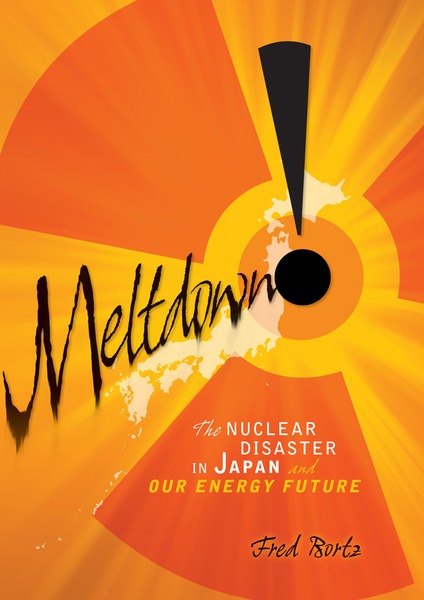
available free from Lerner eSource.
The January 27, 2012, Fukushima status report of the International Atomic Energy Agency reports this good news:
"Plant operators have brought the reactors into a 'cold shutdown condition' defined by TEPCO and the Nuclear Emergency Response Headquarters as:
1) Lowering the coolant water temperature to below 100 degrees centigrade while reducing the pressure inside the reactor vessels to the same as the outside air pressure, or 1 atmosphere (atm); and
2) Bringing release of radioactive materials from primary containment vessels under control and reducing the public radiation exposure by additional release (not to exceed 1 mSv/year at the site boundary as a target)."
"Anti-nuclear movement growing in Asia" by Winifred Bird, Christian Science Monitor, January 27, 2012. Sub-headline: "Though nuclear power still has a strong foothold in Asia, anti-nuclear sentiment and protest are growing from Mongolia to South Korea to Taiwan and even - in modest ways - in China."
The section heading on page 46 of Meltdown! asks this question: "Is Nuclear Power Worth the Risk?" The section doesn't answer the question but describes the ongoing international debate about it. This article shows that the debate is continuing, and that the answer to the question is not a simple one.
"Federal Regulators Approve Two Nuclear Reactors in Georgia" by Matthew L. Wald, New York Times, February 9, 2012
This article discusses not only the news of the license approvals for two new reactors, but also the continuing questions about the long-term future of nuclear power in the United States. The approval came on a 4-1 vote, and the Fukushima meltdowns were the reason for that one objection. "The sole vote against approval was cast by the commission's chairman, Gregory B. Jaczko. He said the license would not assure that all of the safety improvements sought by the agency in response to Japan's Fukushima disaster would be accomplished before the reactors begin operating in 2016 and 2017."
"Japan Ignored Nuclear Risks, Official Says" by Hiroko Tabuchi, New York Times, February 15, 2012.
This goes along with page 45 of Meltdown!, which notes: "Nuclear power plant technology can be safe. Yet the Fukushima Daiichi power plant suffered three meltdowns, two major explosions, and several fires that sent radioactivity into the environment. None of those failures should have happened." (Emphasis in original)
"Crippled Fukushima Nuclear Power Plant at One Year: Back in the Disaster Zone" by David McNeill, The Asia-Pacific Journal, Vol 10, Issue 9, No 4, February 27, 2012. An award winning journalist returns to Fukushima Daiichi one year after the meltdowns and describes the slow pace and challenges of recovery.
"Japan feared 'demonic chain reaction' at reactor, report says by John M. Glionna, Los Angeles Times, Feb. 28, 2012. The subheadline notes: "Officials feared they would have to evacuate Tokyo even as they assured the public that things were under control at the Fukushima nuclear plant, a panel finds." I include this link with some reluctance. The factual information is useful, but the language of the article is potentially biasing in the anti-nuclear direction. For example, the term "chain reaction" does not refer to a nuclear chain reaction, which is the source of energy in a nuclear power plant, but rather a succession of meltdowns and explosions that could have potentially made the disaster much worse than Chernobyl.
Also, it discusses a worst-case scenario and there is considerable debate over whether that scenario was realistic or plausible. Certainly, the policy-makers needed to be aware of that scenario and develop contingencies for it. And certainly serious researchers need to have access to the panel's deliberations. But non-expert readers may not recognize the full context surrounding the material in this article.
"Japanese Prime Minister Says Government Shares Blame for Nuclear Disaster" by Hiroko Tabuchi, New York Times, March 3, 2012. As Meltdown! notes, the political decisions about the future of nuclear power are going to be difficult--even in Japan. As the article notes in its opening paragraph, Japan's new prime minister recognizes the need for nuclear power as well as new policies to deal with it. "Prime Minister Yoshihiko Noda of Japan acknowledged ... that the government shared the blame for the disaster at the Fukushima Daiichi nuclear power plant, saying that officials had been blinded by a false belief in the country's technological infallibility, even as he vowed to push for the idled reactors to be restarted."
"Japan's Nuclear Energy Industry Nears Shutdown, at Least for Now" by Martin Fackler, New York Times, March 8, 2012. As Japanese nuclear plants shut down for routine maintenance, they are not restarting because of objections from citizens who live near them. Only two of Japan's 54 nuclear plants are still operating, and that is causing economic hardship and other difficulties associated with a limited electricity supply. This article shows the mixed feelings that many Japanese people are experiencing with respect to nuclear power as the country struggles to recover from the March 11, 2011, earthquake and tsunami.
"Nuclear Disaster in Japan Was Avoidable, Critics Contend" by Martin Fackler, New York Times, March 9, 2012. This article reports that "some insiders from Japan's tightly knit nuclear industry have stepped forward to say that Tepco [Tokyo Electric Power Company] and regulators had for years ignored warnings of the possibility of a larger-than-expected tsunami in northeastern Japan, and thus failed to take adequate countermeasures, such as raising wave walls or placing backup generators on higher ground." Other critics include James M. Acton and Mark Hibbs of the Carnegie Endowment for International Peace, whose op-ed entitled "Fukushima Could Have Been Prevented" appeared in the Times on the same date.
"Japan's nuclear crisis: Fukushima's legacy of fear" by Geoff Brumfiel and Ichiko Fuyuno, Nature, vol. 483, issue 7388, pp. 138-140, March 8, 2012. Subheadline summary: "Japan's worst-ever nuclear accident displaced more than 100,000 people. Many could now safely return home. Yet mistrust of the government prolongs their exile." An editorial on page 123 of the same issue, entitled "Lessons of a triple disaster," notes the following in its subheadline: "The aftermath of the biggest earthquake in Japan's history, and the tsunami and nuclear disaster that followed, offers a map for preparing for the next catastrophe." Those are two of several useful online articles of a special news feature section of Nature called "The Japanese tsunami: After Shocks."
"Over the Rainbow: If there are better ways to split atoms, they will be a long time coming", The Economist, March 10, 2012, looks at the future of nuclear power, other power sources, and the impact of Fukushima in a world where climate change is becoming an increasingly more important issue. The conclusion (similar to Meltdown's) is: "In a low-emissions world, the role for nuclear will be limited to whatever level of electricity demand remains when renewables are deployed as far as possible."
Fukushima FAQs Fukushima Frequently Asked Questions page of the Nuclear Energy Agency (NEA) which is part of the Organization for Economic Cooperation and Development (OECD), an intergovernmental organization of industrialized countries. The NEA's mission is "To assist its member countries in maintaining and further developing, through international co-operation, the scientific, technological and legal bases required for a safe, environmentally friendly and economical use of nuclear energy for peaceful purposes. To provide authoritative assessments and to forge common understandings on key issues as input to government decisions on nuclear energy policy and to broader OECD policy analyses in areas such as energy and sustainable development." In other words, it promotes the use of nuclear energy but also helps governments develop policies and regulations that can make it safe.
"Fukushima was preventable, experts say" by David Kramer, Physics Today daily edition, March 22, 2012. Subheadline: "A year after Japan's disaster, improvements in US reactor safety are still in process." Excerpt "One year after the accident, the US Nuclear Regulatory Commission is close to issuing several orders to US plant operators in response to lessons learned from Fukushima. One of the orders will require NRC licensees to implement 'mitigating strategies' for accidents that exceed the worst case accident scenarios considered at the time the plants were built."
"Radiation Decontamination in Fukushima: a critical perspective from the ground" by Miguel Quintana. The Asia-Pacific Journal: Japan Focus, March 26, 2012. This article discusses the progress that the Japanese are making toward cleaning the areas radioactively contaminated by the Fukushima meltdowns to enable people to return to their homes and farms.
"One of Japan's damaged reactors has high radiation, little water, renewing stability concerns" by Mari Yamaguchi, Associated Press, Minneapolis Star-Trbune, March 27, 2012. Even though all Tokyo Electric Power workers have achieved "cold shutdown" for all three reactors that melted down at the Fukushima Daiichi plant in the March 2011 disaster, an internal examination of one of them (reactor #2) with special equipment raises concern about its stability. The other two reactors (#1 and #3) are more difficult to examine. To quote the article: "The data collected Tuesday showed the damage from the disaster is so severe, the plant operator will have to develop special equipment and technology to tolerate the harsh environment and decommission the plant, a process expected to last decades. The other two reactors that had meltdowns could be in even worse shape. The No. 2 reactor is the only one officials have been able to closely examine so far."
"Japan nuke-free for the first time since '70," Japan Times, May 6, 2012. Japan's last operating nuclear reactor has shut down for maintenance. Although the government hopes to begin restarting nuclear reactors in time for the summer air-conditioning season, public concern after the Fukushima meltdowns is standing in the way. The Japanese economy suffered badly in 2011 when the country began importing natural gas to generate electricity to replace the temporarily lost nuclear capacity.
The Japanese are faced with difficult choices, and other countries will also face similar questions as power shortages and the need to reduce greenhouse gas emissions come up against concerns about the safety of nuclear power and what to do with nuclear waste. These are the issues that Meltdown! The Nuclear Disaster in Japan and Our Energy Future leaves open for readers.
"A shiny new pipe dream: Capturing the carbon dioxide from power stations is not hard. But it is expensive. A new project in Norway aims to make it cheaper," The Economist, May 12, 2012.
On page 54 of Meltdown!, a sidebar entitled "Clean Coal?" discusses the cancellation of a carbon capture and sequestration (CCS) project to capture and bury CO2 from the smokestacks of a coal power plant because it could not compete economically. This article describes a CCS project that uses a new technique that may be economically viable. An excerpt: "There was a rush of interest in CCS in the late 2000s, including $3 billion for it in America's stimulus package of 2009. But many projects are now being cancelled. Either the developers have lost confidence in government commitments to support them or their costs have turned out higher than expected. Mongstad--a billion-dollar development owned jointly by the Norwegian government and three oil companies, Statoil, Shell and Sasol of South Africa--is a rare exception that has actually opened."
"Fukushima Radiation Estimate Doubles, But Cancer Risk Lower Than Expected," by Jason M. Breslow, PBS Frontline, Inside Japan's Nuclear Meltdown, May 25, 2012.
The latest estimate of radioactivity released in the Fukushima meltdowns is about 18 percent of the amount released at Chernobyl. (That is a bit more than noted in Meltdown!, p.41, where the estimate is 1/7 or about 14 percent.) But human health effects are very limited. That is because people were evacuated from danger zones and the radioactivity was less widespread. On the same page, Meltdown notes that the largest health risk is for the workers who have been bringing the reactors under control. The book states "That gives them a higher than average cancer risk though not a certainty of the disease." This article agrees, stating that "167 workers at the plant received radiation doses that slightly raise their risk of developing cancer."
"Japan considers nuclear-free future: Options require big boost for renewable energy sources," by David Cyranoski, Nature (News and Comment), June 6, 2012. The section of Meltdown! entitled "Is Nuclear Power Worth the Risk?" discusses the response of many nations to the Fukushima disaster. That section mentions many other countries, but it does not discuss Japan's own nuclear (or non-nuclear) future because Japan was too engaged in bringing Fukushima Daiichi under control. Now Japan is discussing alternatives that range from no nuclear power at all to using nuclear to provide up to 25% of Japan's needs. This article puts Japan's difficult decision about its energy future in perspective.
"Japan PM Says 2 Nuke Reactors Must Be Restarted,"
by Mari Yamaguchi, Associated Press, June 8, 2012. Citing serious economic risks if Japan does not begin restarting its nuclear reactors, Prime Minister Yoshihiko Noda said in a news conference that he has begun to take action. Two reactors will restart shortly as the summer air conditioning season is increasing demand for electricity. Many more reactors are likely to follow. According to the article, Noda declared, "We should restart the Ohi No. 3 and No. 4 reactors in order to protect the people's livelihoods. The Japanese society cannot survive if we stop all nuclear reactors or keep them halted."
"Japan panel: Fukushima nuclear disaster 'man-made'" by Mariko Oi, BBC, July 5, 2012. A few days after the startup of the first nuclear reactor in Japan after all had been shut down, a panel of Japanese experts, the Nuclear Accident Independent Investigation Commission (NAIIC), published their report to the Diet (Parliament) and concluded that the Fukushima accident could have been prevented if the government and industry had paid attention to known risks and acted accordingly.
This supports the section of Meltdown! titled "How Safe Are Nuclear Power Plants?", which states: "Nuclear power plant technology can be safe. Yet the Fukushima Daiichi power plant suffered three meltdowns, two major explosions, and several fires that sent radioactivity into the environment. None of these failures should have happened." (p.45) That section then goes on to discuss what engineers and regulators knew could have gone wrong but did not address.
Many other major newspapers printed stories about the NAIIC report, including this one in the Washington Post.
A July 14, 2012, Japan Times editorial about that report was titled "Japan's 'man-made' nuclear fiasco" and noted: "The commission asserted that the direct causes of the accident were foreseeable prior to the March 11, 2011, disaster. But Tepco, the regulatory bodies, and the trade and industry ministry promoting nuclear power failed to develop the most basic safety requirements, including assessing damage probability, preparing for collateral damage containment and developing evacuation plans. Both Tepco and the Nuclear and Industrial Safety Agency (NISA) were aware of the need for structural reinforcement at the Fukushima No. 1 plant to meet new guidelines, stated the commission, but rather than demand that it be done, NISA allowed Tepco to act 'autonomously' and none of the required reinforcements were done by 3/11."
"Japan Sets Policy to Phase Out Nuclear Power Plants by 2040" by Hiroko Tabuchi, New York Times, September 14, 2012. The Japanese government has announced its long-term nuclear energy policy in a document called "Revolutionary Energy and Environmental Strategy." Before the Fukushima disaster, Japan depended on nuclear power for 30 percent of its electricity and had planned to increase that to 50 percent by 2030. The new policy goal is to phase out all nuclear power by 2040, though some of the more recently completed plants, and other plants that were under construction when the disaster struck on March 11, 2011, may be allowed to operate until they reach their design lifetime of 40 years.
Difficult political battles over the policy lie ahead. Many Japanese citizens are unhappy that nuclear power plants may be allowed to operate so long, but other citizens and powerful business interests would like the nuclear industry to continue indefinitely. As the article notes, "While important for setting a tone, the announced strategy is subject to vast change, not only because of the long lead time, but also because the unpopular prime minister, Yoshihiko Noda, and his governing Democratic Party are likely to lose the next national election, which could be called within the next several months."
On October 12, 2012, in an Associated Press article by Mari Yamaguchi entitled "Japan utility agrees nuclear crisis was avoidable," news came that TEPCO, the Tokyo Electric Power Company had finally acknowledged that it could have avoided the disaster. The article notes that TEPCO "said in a statement that it had known safety improvements were needed before last year's tsunami triggered three meltdowns, but it had feared the political, economic and legal consequences of implementing them." As noted above, this supports the paragraph at the top of page 45 in Meltdown! that notes "Nuclear power plant technology can be safe. Yet the Fukushima Daiichi power plant suffered three meltdowns, two major explosions, and several fires that sent radioactivity into the environment. None of those failures should have happened."
The key question for readers of Meltdown! is this. If nuclear power is to be part of our energy future, how can we make sure that our political, economic, and legal system encourages utility companies like TEPCO are encouraged rather than discouraged from making necessary changes when necessary?
In the subtitle of "The Pro-Nukes Environmental Movement" (Mother Jones, January 15, 2013) author Keith Kloor poses this question: "After Fukushima, is nuclear energy still the best way to fight climate change?" As the article states, leading climate-change scientist James Hansen and renowned science author Bill McKibben say yes. However, Kloor notes that solar and wind remain important ingredients, concluding, "Maybe we shouldn't fixate on only one possible path to a low-carbon future, but rather accelerate progress along all the avenues (from nuclear and clean coal to solar and efficiency) that will get us to the same place--a planet with an atmosphere that remains hospitable. There is no guarantee any of them will get us there fast enough to stave off catastrophic climate change, but we have no other reasonable choice."
I encourage readers of Meltdown! to consider the following: There are safety concerns with nuclear power, but they can be addressed technologically if we have the political will. But do we have that will? Or will we, like Germany, try to eliminate all nuclear power, thereby increasing coal-burning and losing much of the benefit of its national push toward more renewable sources? Also consider, as the article does, the impact of the worldwide boom in inexpensive natural gas produced by hydraulic fracturing ("fracking"). Is the economic benefit so great that it is also slowing the growth of wind, solar, and biomass?
This thought-provoking article is a great starting point. But I hope you will not stop there. Please follow the questions it opens up, and discuss them with your fellow citizens and political leaders.
This article by Mark Prigg in the London Daily Mail, posted on January 21, 2013, describes radioactive contamination of fish in the waters off Fukushima. Its title, "Fish caught near crippled Japanese N-plant with 2,500 times the legal limit of radioactivity for human consumption," describes a not unexpected consequence of the meltdowns. Japan will need to monitor its food grown and its fish caught in regions where radioactive contamination from the meltdowns was possible for many years.
John A. Parmentola of General Atomics in San Diego, CA, writes that it is "Time for a game-changing nuclear technology" in a letter to the editor of Physics Today, February 2013, p. 8. He does not discuss the issue of greenhouse gases, but rather writes simply from the standpoint of meeting a rapidly growing world-wide energy demand because of population growth and economic advances. This article has a lot of technical detail, so it is recommended for adult and young adult readers.
Meltdown! does not go into detail about various nuclear reactor technologies, but anyone who thinks seriously about our energy future would be interested in a very promising new nuclear technology known as SMR for "small modular reactor," which is described in this story from Knoxville, TN. The article discusses a plan to test a prototype of the Babcox and Wilcox Company's mPower SMR along the Clinch River in Oak Ridge, TN. It notes, "The mPower reactor will be notable for what it doesn't have. Because of its self-contained design, it won't need the steam generators, pressurizers, coolant pumps and maze of plumbing seen on typical reactors. It won't need gigantic cooling towers.... Its cooling system would work on a cycle in which water cools the reactor core, boils to the top of the vessel as steam, cools, condenses and falls back to the reactor as water. This is an important safety feature because all the pumps and pipes and tanks on a typical reactor are places where leaks can happen."
Almost two-and-a-half years after the meltdowns, Reuters reports on August 8, 2013, that radioactively contaminated water continues to flow from the damaged reactors and threatens to overflow the containment into the ocean. The Japanese government has had to step in because Tokyo Electric Power Company (TEPCO) appears to be incapable of handling the cleanup alone. On the same topic, the British Broadcasting System published this article on August 22, 2013, asking if an international effort is necessary, and if so, why is Japan not requesting help from other countries.
It has always been clear that cleaning up the Fukushima site was never going to be problem-free. But it has also never been clear exactly what problems would be most challenging. This November 2013 article by Toni Feder from the Physics Today website entitled "Japan's Fukushima site is an ongoing morass" describes the current difficulties and the political implications for Japan's energy future and the world's. Its main theme is that experts from all over the world need to be involved in addressing the problems and advising policy makers about meeting the world's energy needs.
On January 30, 2014, science author and broadcaster David Suzuki published an article discussing the potential impact of radiation from the Fukushima meltdowns on fish caught in the Pacific Ocean. He notes that so far, there has been no sign of contamination, but argues that there has not been sufficient monitoring. He describes a new project from the Woods Hole Oceanographic Institute that involves citizen scientists who are willing to sample seawater. Readers should note that Suzuki has a clear point of view, but they should also note that he is willing to accept scientific evidence as the best way to draw conclusions.
The PBS Newshour of February 28, 2014 included a nine-minute report by Miles O'Brien on the difficult clean-up process following the March 2011 meltdowns at Japan's Fukushima Dai'ichi power station. The video cuts off right before his last paragraph, but you can read that in the transcript. A follow-up report on the impact on fish near the reactor site will be broadcast on Wednesday March 5, 2014, and a link will be added here after it airs.
A New York Times editorial on May 1, 2014 argues that the right lesson from nuclear reactor accidents should be policies that make the technology safer, not policies to phase out this important source of energy that does not add carbon dioxide to the atmosphere. The Times editorial board writes: "Whatever the reasons, these sobering trends [away from nuclear power], if left unattended, will make it harder for the United States to meet its goal of reducing carbon emissions by 17 percent below 2005 levels by 2020. The [Center for Climate and Energy Solutions] notes that since 1990 nuclear power has consistently supplied about one-fifth of the nation's electricity and more than 60 percent of all zero-carbon electricity."
In June 2014, several news sources including the BBC reported that the Japanese Nuclear Regulation Authority authorized the Tokyo Electric Power Company to begin building an ice wall to contain radioactive water that is leaking from the damaged reactors. Because the damaged fuel rods need to be cooled, water is constantly being pumped into them, and some has been leaking out carrying radioactive material with it. Most of that has been captured in storage tanks, but some has been released into the ocean. This wall will allow the contaminated water to freeze underground where it can remain for the several years necessary for radioactive activity to drop to safe levels.
According to a January 29, 2015, article at the Climate Central web site, the world will have to double its nuclear electric generating capacity by 2050 to meet its climate change goals (2oC increase or less). The article notes that many countries are beginning to come to terms with the Fukushima accident and that, "Globally, nuclear energy is already making a comeback with 72 nuclear reactors now under construction worldwide, mainly in Asia."
Were the Fukushima meltdowns the result of criminal negligence by Tokyo Electric Power Company executives? That question will be answered in a court of law. As U. S. News reports, the Tokyo district court will try three TEPCO executives because:
"Government and parliamentary investigative reports have said TEPCO's lack of safety culture and weak risk management, including an underestimate of tsunami threats, led to the disaster. They also said TEPCO ignored tsunami measures amid collusion with then-regulators and lax oversight.
"TEPCO has said it could have taken safety measures more proactively, but that a tsunami of the magnitude that crippled the plant could not be anticipated."
Those criminal charges were filed a week before Japan restarted its first nuclear power plant since the March 2011 tragedy and shortly after board members of a Fukushima fisheries union approved a plan to release decontaminated but still radioactive wastewater from the crippled reactors into the sea.
A 21 September 2015 peer-reviewed article in Philosophical Transactions A of the Royal Society concludes that the Fukushima disaster was preventable. As this Science Blog article notes,
"researchers Costas Synolakis of the USC Viterbi School of Engineering and Utku Kanoglu of the Middle East Technical University in Turkey distilled thousands of pages of government and industry reports and hundreds of news stories.... They found that 'arrogance and ignorance,' design flaws, regulatory failures and improper hazard analyses doomed the coastal nuclear power plant even before the tsunami hit.
"'While most studies have focused on the response to the accident, we've found that there were design problems that led to the disaster that should have been dealt with long before the earthquake hit,' said Synolakis.... 'Earlier government and industry studies,... if done properly, would have identified the diesel generators as the linchpin of a future disaster. Fukushima Daiichi was a sitting duck waiting to be flooded."
That fits with this statement on page 45 of Meltdown!: "Nuclear power plant technology can be safe. Yet the Fukushima Daichi power plant suffered three meltdowns, two major explosions, and several fires that sent radioactive material into the environment. None of these should have happened."
On February 26, 2016, nearly five years after the Fukushima meltdowns, the Japan Times reported that three former TEPCO executives would be indicted for criminal negligence. The indictments were expected to be issued on February 29, but the executives were not expected to be jailed unless convicted. The newspaper reported "The Committee for the Inquest of Prosecution said the former executives were presented with a report by June 2009 [21 months before the disaster] saying the plant could be hit by a waves as high as 15.7 meters and that they 'failed to take pre-emptive measures knowing the risk of a major tsunami.'"
In anticipation of the fifth anniversary of the disaster, Bloomberg Business published this excellent overview of the current situation at Fukushima Dai'ichi on March 9, 2016.
According to a May 2016 blog in Scientific American, nuclear energy has a future in the United States thanks to the development of small modular units.
On January 31, 2017, Reuters reported that some of the melted nuclear fuel from reactor number 2 may have been discovered during clean-up operations. If true, this may be a major step to removing dangerous nuclear material from the site. A February 3, 2017 article in the Japan Times describes high radiation levels that appear to confirm the January 31 Reuters story.
A September 6, 2017, report takes on a frequent "fake news" claim that contamination from the Fukushima meltdowns is making fish from the Pacific unsafe to eat. Related false claims are that radioactivity from the meltdowns is reaching North America at harmful levels. Peer reviewed science makes clear that those claims are incorrect. An excerpt from the article states: "These results are consistent with those of the Integrated Fukushima Ocean Radionuclide Monitoring (InFORM) project. Ongoing, scientifically rigorous, monitoring of the marine environment provides the best evidence with which to gauge the risk that the FDNPP [Fukushima Daiichi Nuclear Power Plant] meltdowns represent for marine and public health here in North America."
One of the most concerning contaminants released by the 2011 meltdowns at Fukushima Daiichi is cesium-137. This Science News article from October 2, 2017, notes that the isotope has been found in higher than expected concentrations in the groundwater underneath nearby beaches. "[S]eawater tainted with high levels of cesium-137 probably traveled along the coast and lapped against these beaches, proposes study coauthor Virginie Sanial.... Some cesium stuck to the sand and, over time, percolated down to the brackish groundwater beneath. Now, the radioactive material is steadily making its way back into the ocean." Since that groundwater is not used for drinking water, it is not a public health hazard. But the results are important to know in case of future reactor accidents.
In March 2019, author Kate Brown published a book called  Manual for Survival: A Chernobyl Guide for the Future that provides more detail on the impact of the Chernobyl explosion and meltdown than is included in Meltdown!, including ongoing effects of the widespread contamination from the event.
As the tenth anniversary of the Fukushima meltdowns approaches, it is useful to track the progress of the multi-decade clean-up. Here is an Associated Press news story from December 27, 2019, which describes slower than anticipated progress.
What has happened to life near the site of the meltdowns, Japanese life in general, and Japanese energy policy in the nearly ten years since the tragic event? The 2020 NPR radio series "Recovering Fukushima" answers some of those questions.
Author Fred Bortz's post at Lerner Blog on the tenth anniversary of the disaster.
See Other Resources for reports, books, and television programs published or broadcast after Meltdown!, including two remarkable Frontline documentaries.
Order  Meltdown! in hardcover or eBook from the publisher
 Order Meltdown! in library binding from Amazon.com
 Meltdown! was featured at the 2012 USA Science and Engineering Festival Book Fair at the Washington DC Convention Center on Saturday, April 28, 2012.
Go to main Meltdown! webpage.
Go to "Dr. Fred's Place" homepage.
Text copyright 2011-20 by Alfred B. Bortz, all rights reserved

[Dr. Fred's Office |What's
New? | Meet Dr. Fred! |
Books By Dr. Fred |
Ask Dr. Fred |
School Visits | Links To
Fellow Writers ]
Dr. Fred logo and art may not be reproduced in any form for commercial or educational use without the written permission of its owner, Alfred B. Bortz.